


The Human Fascination with Machines: A History of Our Passion for Motion
From steam power to combustion and electrification: how machines changed the world and why they continue to inspire wonder, curiosity and passion.
“Fascination lies not only in the power a machine produces, but in the curiosity it awakens.”
Some machines become part of everyday life without attracting a second glance. Others can stop a conversation: someone recognizes a sound, watches a gear turn, notices a restoration in progress and walks over to see how it works. Curiosity comes before explanation.
Human fascination with machines did not begin with the automobile, nor is it limited to speed. It is a much older story, shaped by trial and error, the desire to master movement, and an admiration that is hard to separate from human experience. Over the centuries, we have built machines to work, travel and overcome limitations. At some point, we began to love them as well.
01 From Origins to Revolution
Before combustion, there was already a desire for motion
Long before a combustible mixture entered a cylinder, waterwheels powered mills, wind drove vessels, and systems of levers, pulleys and gears multiplied human effort. The machine was an extension of the human body: it made possible tasks that would have been slow, dangerous or impossible with muscle power alone.
Those inventions embodied a question still asked in workshops today: how can we make better use of the force available? The answer was never simply to add power. That force had to be directed, its rhythm controlled, transmitted and converted into useful work.
Steam turns force into revolution
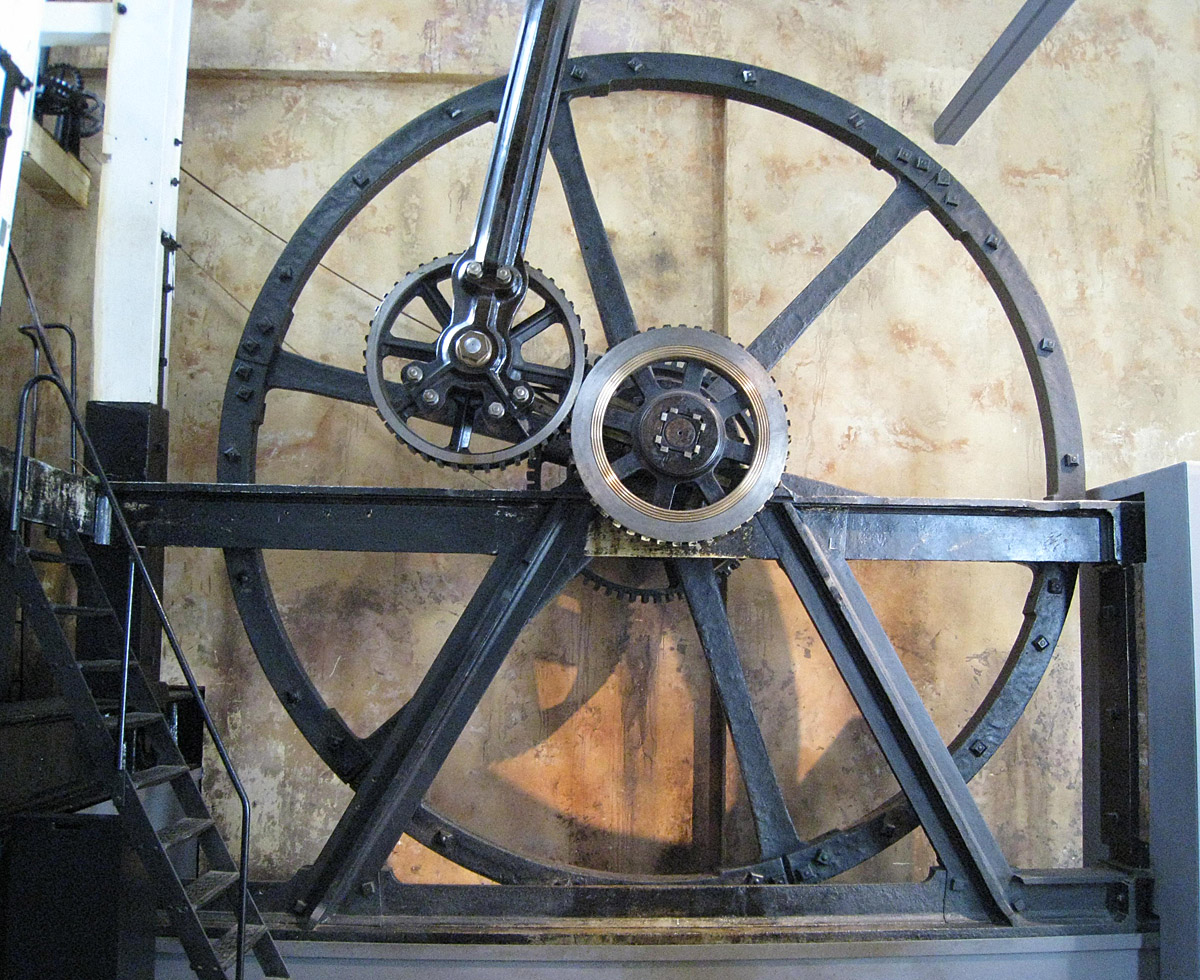
In 1712, Thomas Newcomen built an atmospheric engine to pump water out of mines. Steam was condensed inside a cylinder, creating a region of low pressure; atmospheric pressure then moved the piston. The principle must have seemed almost magical in its day, but it required repeated heating and cooling, wasting substantial energy.
Decades later, James Watt developed the separate condenser, patented in 1769. This change avoided repeatedly cooling the working cylinder and represented a major improvement in efficiency. Later refinements helped extend steam power to a growing range of industrial applications.
As industry expanded, mechanical motion began to shape factories, transport and new ways of producing goods. The machine was no longer merely a standalone tool: it became part of the landscape, the workplace and the idea of progress. The Science Museum documents how Newcomen’s engine worked, while historians of science have explored Watt’s contribution.

02 Machines Take to the Roads
When the machine left the factory and took to the roads
The nineteenth century brought a new ambition: to concentrate energy in mechanisms compact enough to travel with people. In 1876, Nikolaus Otto introduced a successful four-stroke internal-combustion engine design. His contribution helped establish an architecture that would become fundamental to later mobility.
Progress did not follow a single path. Inventors experimented with fuels, ignition, cooling systems and different operating cycles. Carl Benz, for instance, put a stationary single-cylinder two-stroke engine into operation in 1879. Years later, his three-wheeled vehicle—completed in 1885 and patented on 29 January 1886—would use a four-stroke engine rated at approximately 0.75 horsepower.
The next step required more than a patent. The world needed proof that the automobile could cope with actual roads. In 1888, Bertha Benz and her sons undertook a long-distance journey that helped demonstrate the invention’s practical viability. The history preserved by Mercedes-Benz records this pivotal chapter.


From necessity to passion
What turns something built to solve a problem into an object of affection? Part of the answer lies in experience. A machine communicates its condition through sound, vibration, temperature and response to controls. Those who live with one learn to detect an irregularity, appreciate a precise adjustment and celebrate when a mechanism starts working again.
Knowledge is also passed from one generation to the next. A workshop can hold as many stories as tools. An inherited motorcycle, a vehicle brought back to life after years of disuse, or a part made by hand can carry memories that no specification sheet could contain. Admiration does not always arise from high power output. Sometimes it comes from the persistence required to restore motion to something that seemed lost.
That is why old machines continue to attract collectors and restorers, even when modern alternatives are more efficient. The value of a creation may lie as much in what it represents as in what it does.
03 Passion, Speed and Engineering
Competition as a laboratory for ingenuity
The pursuit of speed and performance added another dimension to this fascination. On racetracks and in endurance events, engineers, mechanics and drivers push designs to their limits, balancing power, mass, traction, consumption, reliability and control.
Improving performance is not simply a matter of making the numbers bigger. Changing one component alters the operating conditions of others. A transmission must suit the machine’s useful speed range; cooling must manage the heat being rejected; the entire assembly must function under demands that never stop changing.
It is here that practical experience meets physical models. An apparently simple solution may conceal remarkably sophisticated engineering.
The deceptive simplicity of two-stroke machines
Two-stroke combustion engines have earned a special place in motorcycle and motorsport culture. The relatively small number of moving parts in many of these designs can give an impression of simplicity. Their actual behaviour, however, depends on complex dynamic phenomena.
In designs with port-controlled intake and exhaust, piston movement, port geometry, gas flow and exhaust pressure waves form a strongly coupled system. Changing a single dimension does not guarantee an isolated or predictable gain. Often, the intended result appears only when the components work together.
This combination of mechanical elegance and physical complexity helps explain their appeal. Understanding how such an engine works can be as rewarding as listening to its response to the throttle.


04 What Changes and What Endures
Machines change. Curiosity endures.
Today, electric motors, electronic control systems and new propulsion technologies are transforming our relationship with motion once again. Electrification changes sounds, sensations, maintenance requirements and design possibilities. It does not remove the need for ingenuity; it presents different engineering challenges.
A new technology does not have to erase the history of its predecessor. Steam engines remain essential to understanding industrialization. Combustion-powered vehicles carry the memories of families and sporting events. Emerging solutions continue to open paths we are only beginning to explore.
Fascination, then, belongs to no single type of propulsion. It grows from the human ability to imagine mechanisms, understand their limitations and improve them.
A place for those who want to understand
PowerTunePro springs from that same restless curiosity: looking at a machine and wanting to see beyond its surface. Asking not only how much it can deliver, but how it works, why it was built that way, which decisions shaped its history and what ideas might transform it.
Here, culture and engineering need not live apart. A good story can raise a technical question; a discovery in the workshop can lead back to an invention from the past. That exchange is how lasting knowledge is built.
Perhaps this is the true source of humanity’s fascination with machines: every mechanism brings together something we already know and something we have yet to discover. As long as people remain curious about motion, there will be new stories to tell.